Are You Ready to Push Through Adversity?
How has adversity affected your baseball or softball career in the past? Did your perceptions or reaction to adversity worsen matters?
Baseball and softball seasons are long, and you are bound to hit some adversity along the way, no matter who you are or the level at which you compete.
Adversity, such as slumps, injury, limited playing time, or a lack of progress, can deeply affect your mental game.
How you manage that adversity determines the player you will become.
A collegiate player who responded to our Softball and Baseball Mental Toughness Survey asked the following:
“When you face adversity during the season, how can you stay confident and push through?”
Adversity can be difficult and frustrating, whether it’s injury, slumps, or lack of playing time. Your mind will immediately jump to how your situation is unfair, “Why does this always happen to me? I never get any breaks. I work so hard. This is messed up.”
These thoughts keep you trapped and focused on the problem. It is important to process those thoughts and emotions, rather than bury them. However, it is just as important to work towards a solution.
Positive action helps you regain a sense of control, maintain confidence, and come out of the situation mentally stronger. Work towards a solution instead of dwelling on the problem or allowing your circumstances to affect your mood, confidence, and performance.
If you are in a slump, work on mechanics with your coach. If you are recently injured, work with the rehab team to become mentally and physically stronger.
If you are suffering from a lack of confidence, work with a Mental Game Coach to learn confidence-building or refocusing strategies to improve your game.
When you are struggling with adversity, stay positive and trust that the work you are putting in will pay off. How you respond to adversity can be just what you need to make you a better, mentally tougher player.
Take, for example, Tampa Bay Rays pitcher Shane McClanahan. McClanahan was selected to consecutive All-Star teams in 2022 and 2023. Shortly after the 2023 All-Star game, McClanahan’s season ended due to a shoulder injury that eventually required Tommy John surgery.
While not being able to play, McClanahan still put in the work to be a better player. McClanahan’s diligence paid off as he was named the Rays’ 2025 Opening Day starter.
Despite the daunting adversity, McClanahan viewed his circumstances as an opportunity to improve.
McCLANAHAN: “You’ve got to have your mind set on something, and my mind was set on coming out of this better than I was before. It was a long year and a half, but I got a lot of good out of it.”
During his break from the game, McClanahan took advantage of the situation and focused on what he could do to improve his game.
McClanahan worked with a dietitian, athletic trainers, and team staff to gain 20 pounds of muscle, strengthen his arm through weightlifting, and create a recovery plan to relieve some stress from his arm throughout the season.
McCLANAHAN: “It was a process, but it was a fun process for me because I got to work at something. During that whole time of Tommy John, it’s like the only thing you can compete with is yourself in the training room, the diet, the rehab, and how well you prioritize recovery.”
Adversity is unavoidable in baseball and softball, but how you respond to it defines the type of player you become. Whether it’s a slump, an injury, or a lack of playing time, your mindset and actions determine whether you grow stronger or let challenges hold you back.
When facing adversity, shift your focus from the problem to the potential opportunities. Look for areas you can improve. Set small, achievable goals, and stay disciplined in your mental and physical training.Growth happens when you embrace the challenge and commit to the process of getting better.
Related Sports Psychology Articles
- Are Your Trying too Hard at the Plate When Hitting?
- How this Yankee Manages Losses in the World Series
- The Psychology of Baseball: Dealing with Pressure
*Subscribe to The Sports Psychology Podcast on iTunes
*Subscribe to The Sports Psychology Podcast on Spotify
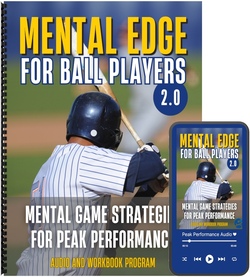
The Mental Edge for Ball Players (Digital Download)
“The Mental Edge for Ball Players” audio and workbook program teaches you to get a competitive edge in baseball and softball by overcoming a lack of focus, low self-confidence and other mental game obstacles. Learn practical mental strategies to improve your performance in competition.
“A quick note to let you know how effective your programs worked for my son who is 17 and plays varsity baseball in VA. In late 2009, I ordered the “Relaxed Athlete Program” for my son because I saw he was pressing too hard at the plate and had disappointing results for his season. Thanks to your programs, my son now has a completely new approach to the game of baseball (and school) and it’s more fun for him now. He made all-district player at his position and hit .443 this season. A complete 180 degree turn around from last year.”
~Mark M., Sports Parent