Table of Contents
Developing The Mental Toughness of a Champion
Summary: Mental toughness — made up of traits like flexibility, resilience, and laser-like focus — often separates elite players from the rest, especially in high-pressure playoff situations. This article breaks down the key elements of mental toughness using Justin Verlander’s playoff performance as an example.
Mental Toughness for baseball players is a vital component to grow as an athlete and achieve a high level of success as a ball player.
Mental toughness in baseball is often the difference between success and failure.
Your level of mental toughness determines how you respond to injury, slumps, tough competitions, pressure situations and how you approach your game.
Mental toughness in baseball can be developed through diligent practice and is composed of several elements:
- Flexibility (find new ways to overcome adversity)
- Action-oriented (view challenges as opportunities to reach new levels of performance)
- Inner strength (reach deep down inside in order to respond positively to pressure situations)
- Courage (seek to overcome obstacle the right way through hard work and determination)
- Resiliency (remain optimistic and confident in the face of adversity)
- Laser-like focus (stay focused under pressure on what they need to do in that moment)
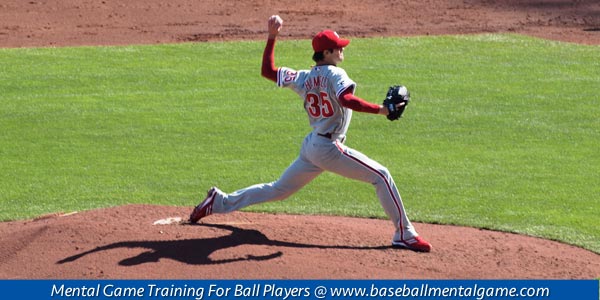
Justin Verlander, pitcher for the Detroit Tigers, is considered by many one of the best pitchers in MLB and one of the mentally toughest players in the league.
Verlander has achieved many awards and accolades since entering the league in 2005: Rookie of the Year, five-time All Star selection, Cy Young award (2011) and league MVP (2011).
Verlander had his second worst season (13-12) since being selected as the best rookie in the league and almost as many losses in his two previous seasons combined (41-13).
How would Verlander respond pitching the deciding game of the ALDS against the Oakland A’s in Oakland?
With the season on the line, Verlander utilized his mental toughness and rose to the challenge and pitched a gem by carrying a no-hit bid into the seventh inning. Verlander allowed only three baserunners (2 hits), struck out 10 hitters in eight innings to win the series, 3-0, and helping the Tigers advanced to the ALCS.
Verlander had nerves of steel, trusting his stuff and displayed his trademark mental toughness,
“I’m pitching the way I’m supposed to. I worked my butt off all year to try to get consistent and get myself where I needed to be. I feel like it finally paid off at the end of the year.”
How can you develop the “Mental Toughness” of a champion?
- Be committed to mastering the basics and find new ways to improve your abilities.
- Don’t allow challenges beat you. Use challenges to springboard you to greater heights.
- Embrace pressure situations and learn to harness your emotions to benefit performance.
- Outwork your opposition and be diligent in your preparation.
- Stay positive and trust your abilities.
- Focus on the present play. You are most effective and powerful when you play in the present moment.
Outstanding athletic talent and physical prowess will only take you so far in baseball.
Mental toughness is the key to unlock your full potential.
FAQ
What elements make up mental toughness in baseball?
Flexibility, an action-oriented mindset, inner strength, courage, and resiliency, along with laser-like focus under pressure.
Why does mental toughness matter in the playoffs specifically?
Playoff situations amplify pressure, and mental toughness determines how a player responds to that added pressure compared to a regular-season game.
What role does resiliency play in mental toughness?
Resiliency means remaining optimistic and confident in the face of adversity, which helps players continue performing under difficult circumstances.
How is Justin Verlander an example of mental toughness?
Verlander is widely regarded as one of the mentally toughest pitchers in MLB, particularly for his composure in high-stakes games like a deciding ALDS matchup.
Related Sports Psychology Articles
- Mental Toughness is a Baseball Skill
- World Champions’ Mental Toughness
- How to Stay Mentally Sharp While in the Dugout
*Subscribe to The Sports Psychology Podcast on iTunes
*Subscribe to The Sports Psychology Podcast on Spotify
Instilling Confidence in Baseball And Softball Players

Confidence, more than any other mental game attribute, is vital for your team’s success. If your players have it and know how to keep it, they maximize their success. Your team cannot reach their full potential unless each player can harness the power of stable and enduring self-confidence–so your team can perform as a confident team.
Your players might possess a ton of physical talent, have great coaching, and train harder or practice more than anyone else in your league, but if they do not have the self-confidence to match, your team can’t utilize this talent.
“Instilling Confidence in Baseball and Softball Players” program consists of one 72-minute audio CD that includes 7 days of confidence-fueling exercises. You’ll also receive a simple-to-follow 74-page coaches’ manual that guides you through the 7 team session you’ll conduct!