Table of Contents
Would you describe yourself as a “nervous” player?
Summary: Nervousness in high-pressure moments — tight forearms, a pounding heart, gripping the ball too hard — is common, but it doesn’t have to derail your performance. This article shares methods for reframing nervous energy as excitement so you can stay focused when it matters most.
Does anxiety get the best of you in big moments?
Maybe you can relate to the following scenario.
You are warming up in the bullpen during a tied game. The pitcher on the mound just walked the bases loaded with just one out. You hope your number is not called. The thought of giving up a game-winning run is too overwhelming.
Unfortunately, the manager signals you to enter the game. You feel your heart pounding, and you keep thinking, “Don’t mess up.” Your forearms feel tense, and you grip the ball tighter.
Instead of trusting your pitches, you try to throw harder to strike out the current batter, but you can’t find the strike zone and end up walking in a run, giving the opposing team a one-run lead.
Even though you experience nervousness, you have the power to calm your nerves and perform your best.
How can you minimize your nervousness so you can focus and perform your best during ball games?
The following are effective methods to keep your head in the game:
- Know that you have the capacity to manage your nerves.
Too often, players accept they are the nervous type and believe they can do nothing to change it.
- Change your perspective.
Instead of seeing the moment as a time to mess up, think of it as an opportunity to show up and prove to yourself that you have the ability to perform under pressure.
- Build confidence through mental training.
Mental training helps you manage the moment, deal with pressure, and build confidence.
- Use practice to hone and build trust in your skills.
Confidence improves through training and repetition. When you build positive habits and hone your mechanics, you will believe in your ability to replicate those skills in games.
The two important points to make about feeling nervous are (1) you have the ability to regulate your nerves, and (2) you can play at a high level despite feeling slightly nervous.
In his Major League Baseball debut for the Boston Red Sox, pitcher Naoyuki Uwasawa was called upon in the eighth inning with the Red Sox trailing the San Francisco Giants, 3-1.
Despite feeling nervous, Uwasawa managed his nerves, struck out one, and retired all six batters he faced in the game.
UWASAWA: “I thought I wouldn’t be nervous, but when I stepped on the mound it was an incredible feeling, I was able to put into practice the things the team has been asking me to work on since Triple-A. I want to prepare so that I can properly carry out the role I’ve been given.“
All baseball players, from Little League to MLB, experience nervousness. The difference between those who rise to the occasion and those who falter under pressure is that successful players have learned how to manage their nerves so they can perform at their peak.
The good news is that you, too, can learn the same mental skills to regulate your nerves and perform under pressure.
Change your relationship with nerves. Start thinking of nerves as a controllable aspect of performance. You are not a victim of nervousness; you are the regulator of nerves.
In other words, you have the power to dial down nerves so you can be your best during games.
FAQ
Why do I get so nervous in big moments?
A perceived threat, like entering a tied game with the bases loaded, triggers physical tension — a pounding heart, tight forearms — that can throw off your execution if unmanaged.
Can nervousness actually be controlled?
Yes — too many players assume they’re just “the nervous type” and can’t change it, but nervous energy can be managed and redirected.
What’s the first step to managing nerves?
Recognizing that you have the capacity to manage your nervous energy rather than accepting it as a fixed trait.
How can I reframe nervousness in a big moment?
Change your perspective from seeing the moment as a chance to fail to seeing it as an exciting challenge and opportunity.
Related Sports Psychology Articles
- One Baseball Myth About Playing with Nerves
- How to Manage Your Nerves for Ball Players
- How to Recover in the Middle of a Game
*Subscribe to The Sports Psychology Podcast on iTunes
*Subscribe to The Sports Psychology Podcast on Spotify
Get the Mental Edge With Mental Game Coaching
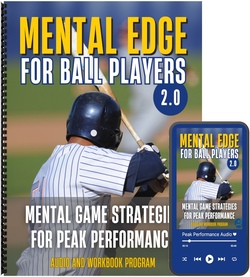
Mental game coaching helps serious athletes like you uncover the beliefs and attitudes that keep you from performing to your potential. You’ll learn mental game strategies to perform confidently in competition and how to overcome performance barriers.
You can improve your mental game with Peaksports Mental Game Coaches one-on-one sessions with from anywhere in the world via telephone, Zoom, or FaceTime.
One-on-one mental game coaching is the fastest and most effective method to improve your mental game, boost your performance, and make lasting changes. We have a variety of mental coaching programs to choose from.
Please call us at 407-909-1700 with your questions.